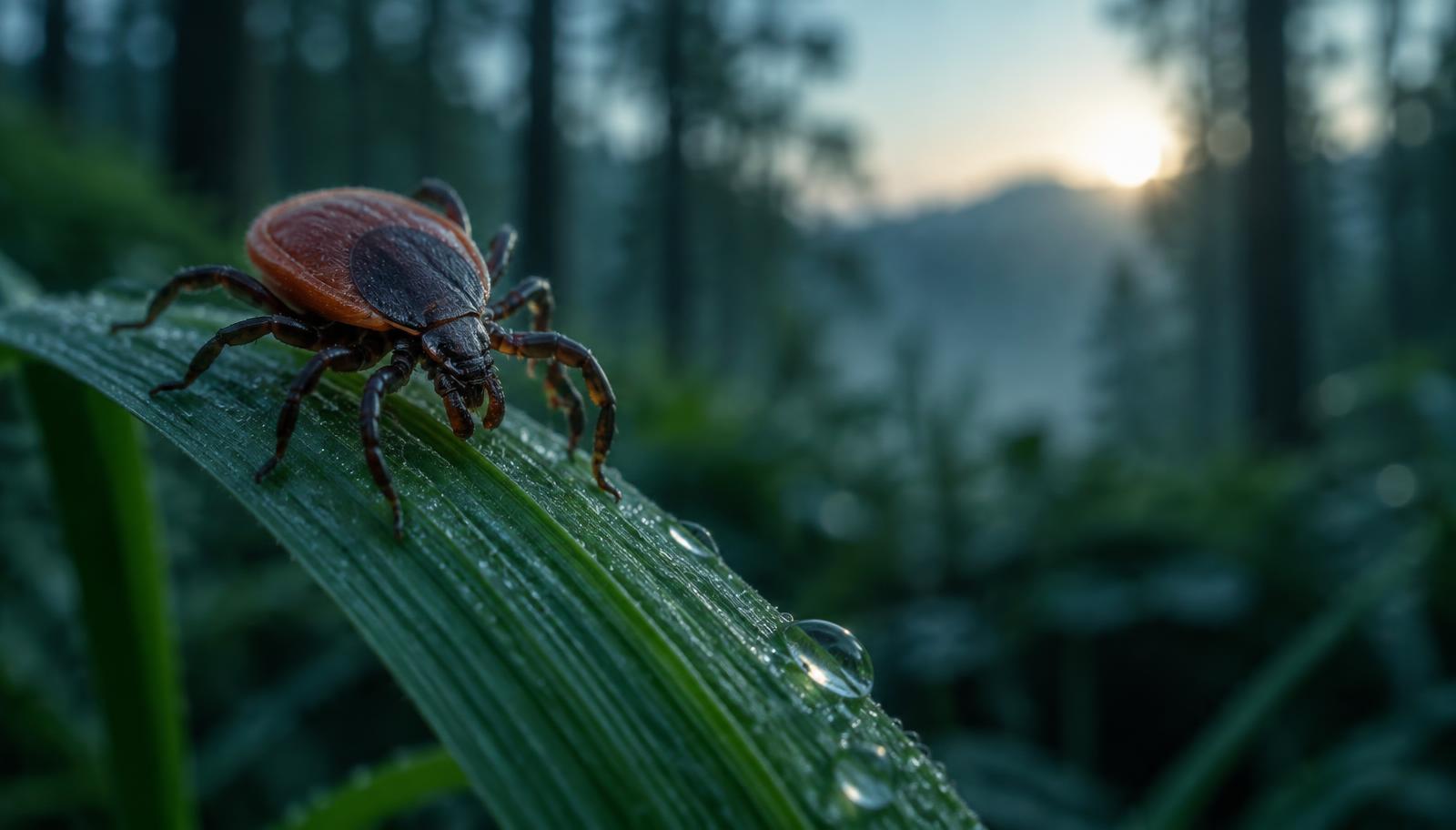
A tick-borne blood parasite
Babesia hides in your red blood cells — and in most patients, nobody looks.
Babesiosis is a malaria-like infection spread by the same ticks that spread Lyme disease. It can also pass through blood transfusion and from mother to child. It is far more common than routine healthcare assumes, and the tests doctors usually reach for miss a great deal of it.
What Babesia actually is
Babesia is a protozoan parasite — a single-celled organism, not a bacterium — that invades and multiplies inside red blood cells. Under a microscope it looks strikingly like malaria, and the illness it causes behaves in a similar way: fever, haemolysis (destruction of red cells), fatigue and, in vulnerable people, organ failure.2012
More than one hundred Babesia species exist. The ones that make humans ill include Babesia microti (dominant in North America), and B. divergens and B. venatorum in Europe, all carried by Ixodes ticks — the same sheep and deer ticks that transmit Lyme borreliosis.2021
Why it goes unnoticed
Healthy people with an intact spleen often clear enough of the parasite to stop feeling acutely ill, while a low-level infection persists for months or even years. Studies of immunocompromised and treated patients document persistence and relapse long after the initial episode.2008
That low parasite load is exactly what standard diagnostics struggle with. A blood smear may show one infected cell in tens of thousands — or none on the day it is taken. Antibody tests can be negative early and positive for years after clearance. PCR is sensitive but only when the parasite happens to be circulating at the time of the draw.20152023
Start here
- Symptoms and long-term effects — from air hunger and night sweats to haemolytic anaemia and splenic rupture.
- Diseases that travel with Babesia — Lyme, Anaplasma, Bartonella, TBE and the conditions Babesia is mistaken for.
- Testing, including DualDur — the simplest route to an answer, and why the tests your GP can order are ordered so rarely.
- Treatment — the antibiotic combinations with trial evidence, and the botanicals with laboratory evidence.
- Every source — PubMed, peer-reviewed journals and Swedish public media, listed in full.